Dedicated Server
Cheap Server
Best Server
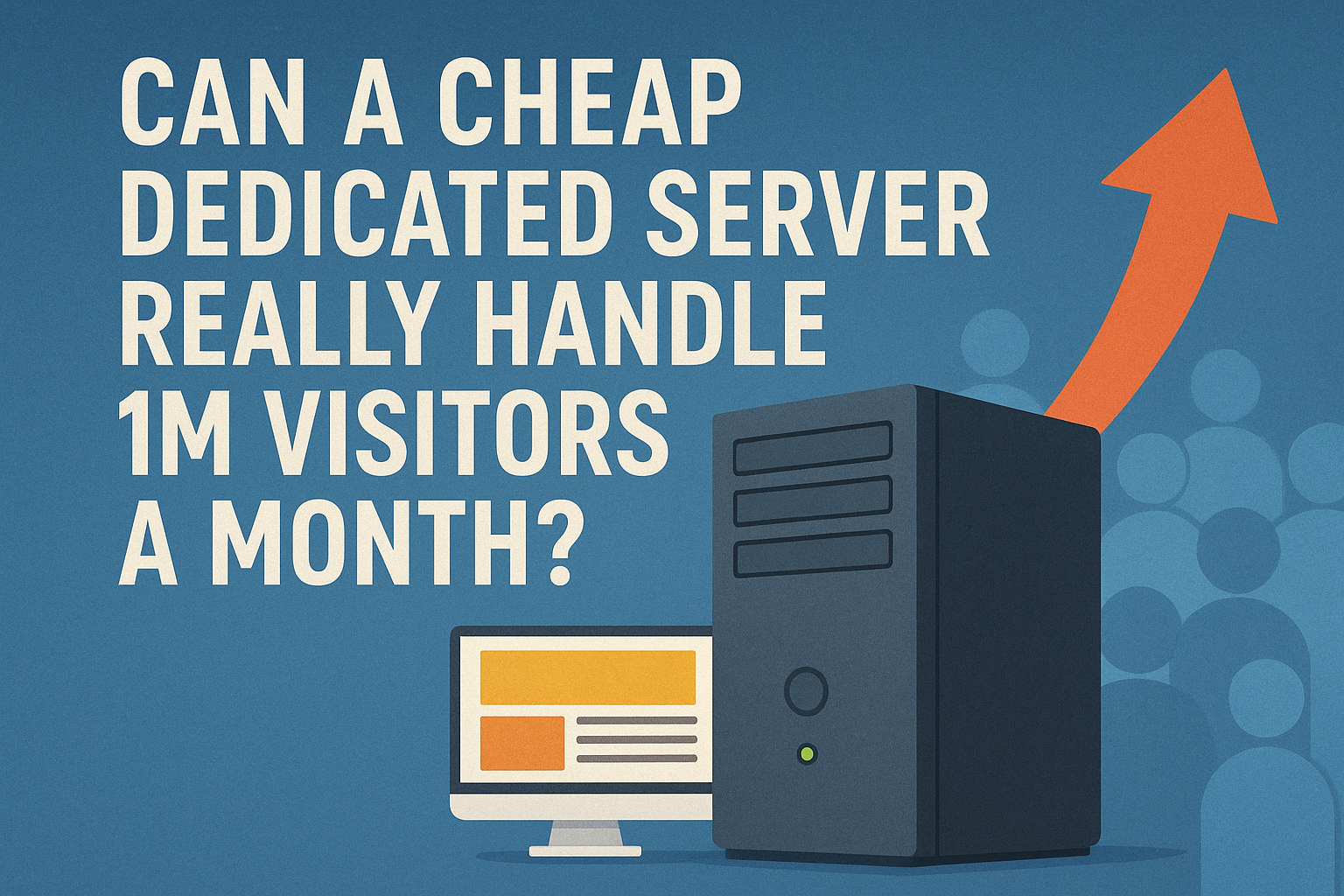

In the digital era, website performance is no longer a “nice to have”—it’s the backbone of online success. Whether you’re running an e-commerce store, a SaaS platform, or a high-traffic blog, you’ve probably wondered:
“Can a cheap dedicated server really handle 1 million visitors a month?”
It’s a fair question. After all, “cheap” and “high performance” don’t usually go hand in hand. But hosting has evolved significantly in recent years, and the right dedicated server—yes, even an affordable one—can scale to handle massive traffic. The key lies in understanding what you’re paying for, how servers work, and how to optimize them.
In this post, we’ll break down everything you need to know, from what “cheap dedicated server” really means to whether it’s realistic to host 1M+ visitors a month without your site slowing to a crawl.
A dedicated server means all resources—CPU, RAM, storage, and bandwidth—are reserved for you. Unlike shared hosting, where you’re splitting resources with hundreds of sites, or a VPS, where you get a virtualized slice of a physical server, a dedicated server gives you full control.
Now, the word cheap doesn’t always mean “low quality.” In hosting, it usually refers to:
Affordable entry-level plans offered by providers to attract startups and small businesses.
Basic but solid hardware (like older-gen CPUs, sufficient RAM, and SSD storage).
Limited add-ons (you may not get premium support, backups, or advanced security unless you pay extra).
So, a cheap dedicated server might not be “barebones,” but it won’t match enterprise-grade machines either. The question is whether the balance of cost vs performance is enough to support 1 million monthly visitors.
Let’s first put that number into perspective.
1,000,000 monthly visitors = roughly 33,000 visitors per day.
Spread evenly, that’s 1,375 visitors per hour or around 23 visitors per minute.
Now, most traffic isn’t evenly spread. You’ll likely see spikes during promotions, product launches, or peak business hours. This means your server must handle bursts of traffic—sometimes thousands of users hitting your site within a few minutes.
Whether your cheap dedicated server can manage this depends on:
Server specifications (CPU cores, RAM, SSD vs HDD, bandwidth limits).
Website optimization (caching, image compression, database tuning).
Traffic type (are users just reading articles, or are they uploading files, streaming video, or making transactions?).
Software stack (Apache vs NGINX, PHP vs Node.js, MySQL tuning, etc.).
The short answer: Yes, it can—if it’s configured and optimized correctly.
Here’s how:
Most cheap dedicated servers come with:
CPU: Intel Xeon E3/E5 or AMD equivalents (4–8 cores).
RAM: 8GB–32GB.
Storage: SSDs for faster read/write speeds.
Bandwidth: Anywhere from 1TB to unmetered traffic.
A setup like this is more than capable of handling millions of monthly visits if your site is coded efficiently. For content-heavy sites (blogs, news portals), the load per visitor is minimal compared to, say, a video streaming platform.
Even if your server is powerful, network limitations can bottleneck performance. A provider offering 1Gbps uplink with unmetered or high bandwidth allocation is ideal. Always check the fine print—some “cheap” plans throttle speeds after certain usage.
A cheap server with poor configuration will struggle. But with the right stack, you can do wonders:
Use NGINX or LiteSpeed instead of Apache for faster request handling.
Implement caching layers (Redis, Varnish, or CDN-level caching).
Optimize your database queries (MySQL/MariaDB tuning).
Deploy a Content Delivery Network (CDN) like Cloudflare to offload traffic.
Let’s assume you’re running a WordPress site. A well-optimized cheap dedicated server with 8 cores, 16GB RAM, SSD storage, and CDN support can comfortably handle 1M–3M monthly visits, provided your site uses caching plugins (like WP Rocket or W3 Total Cache) and a lightweight theme.
✅ Cost Savings – You can save 40–60% compared to premium servers.
✅ Full Control – Root access lets you fine-tune performance.
✅ Scalability – Many providers let you upgrade RAM, storage, or bandwidth easily.
✅ Isolation – Unlike shared hosting, your resources aren’t “borrowed” by others.
⚠️ Lower-tier Hardware – You may not get the latest CPUs or NVMe SSDs.
⚠️ Limited Support – Budget providers often charge extra for managed support.
⚠️ No Auto-Scaling – Unlike cloud hosting, dedicated servers don’t scale instantly—you must plan ahead.
⚠️ Single Point of Failure – If the server crashes, your site goes down unless you set up redundancy.
If you’re serious about scaling, here are practical strategies:
Use a CDN – Offload static files like images, CSS, and JS.
Implement Caching – Page caching can reduce server load by up to 80%.
Optimize Images & Code – Compress files and lazy-load images.
Load Balancing – If traffic grows, distribute visitors across multiple servers.
Monitor & Test – Use tools like GTMetrix, Pingdom, and ApacheBench to stress-test performance.
Yes—a cheap dedicated server can absolutely handle 1M visitors a month, but only if:
You choose the right specs (8+ cores, 16GB+ RAM, SSD storage).
You configure caching, CDN, and database optimizations.
You monitor performance and upgrade as traffic grows.
For content-driven sites, blogs, and e-commerce stores, a $60–$100/month cheap dedicated server can handle the load. For video streaming, gaming, or real-time apps, you may need to invest in higher-tier or clustered solutions.
Cheap doesn’t mean weak anymore. Hosting providers today offer affordable dedicated servers that are powerful enough to support high-traffic websites if you know how to optimize them.
So, the next time you hear someone say “cheap servers can’t scale”—remember, it’s not just about the server. It’s about how you use it.
If you’re planning to hit the 1M visitors/month milestone, start with a cheap dedicated server, configure it wisely, and grow from there. You’ll be surprised at just how far it can take your business.